

The New "Must-Haves": Beyond Basic Insulation
Gone are the days when insulation alone won customer loyalty. Today’s top-performing products excel in three key areas:
1. Smart Connectivity: The "Personal Hydration Assistant"
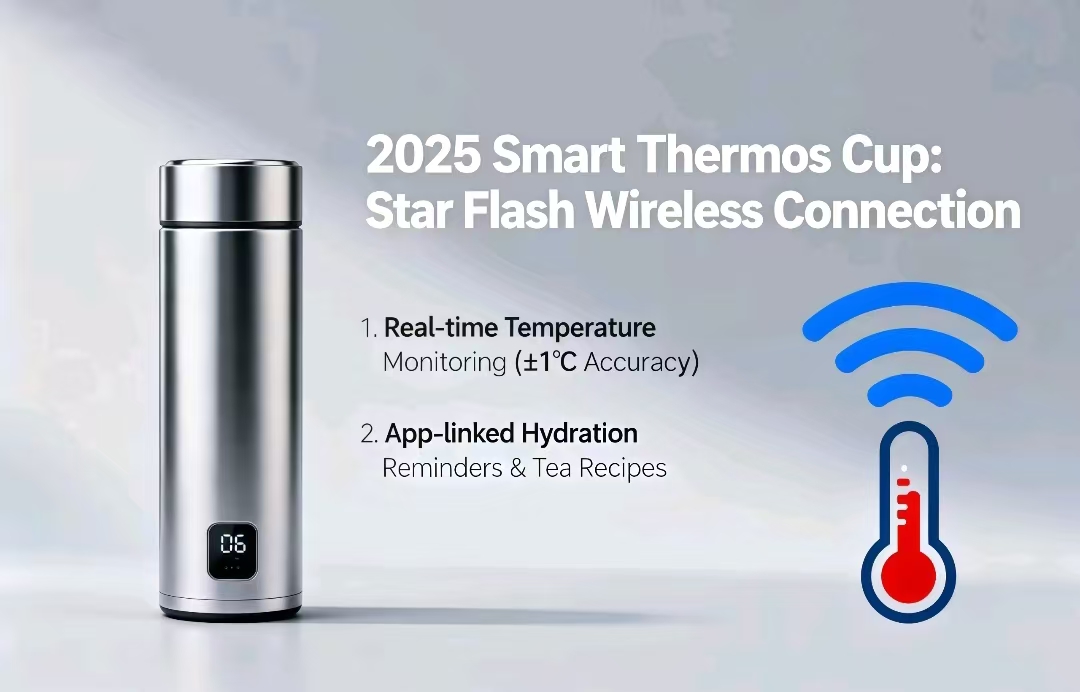
Smart thermoses have moved from niche gadgets to mainstream essentials, fueled by consumer demand for health tracking and convenience. The 2025 launch of the Hals x Huawei Smart Tea Tumbler with StarFlash—the world’s first thermos integrating China’s homegrown StarFlash wireless technology—epitomizes this shift . It connects to the Huawei Smart Life app via low-latency, high-reliability StarFlash, offering features like:
- Real-time temperature monitoring (±1℃ accuracy, meeting 2025 industry standards )
- Pre-programmed tea-brewing recipes from master blenders (e.g., optimal water temp for oolong vs. pu’er)
- Hydration tracking with app-generated reports and vibration reminders for refills.
This innovation isn’t just for tech enthusiasts: by 2026, smart thermos penetration is projected to jump from 12% to 35% globally, creating a $5 billion+ niche market . Brands like Thermos and Zojirushi are racing to catch up, with app-connected models now accounting for 40% of their premium line sales .
2. Sustainability: Carbon Transparency as a Selling Point
Eco-consciousness has evolved from a "nice-to-have" to a non-negotiable, especially in Western markets. Stanley’s Carbon-Neutral Collection leads the pack, boasting 85% recycled stainless steel (sourced from repurposed aluminum cans) and bio-based silicone seals made from corn starch—cuts that reduce the product’s carbon footprint by 42% . The line’s SCS Global Services certification (the "Michelin star of sustainability") has driven a 27% price premium and 15% higher profit margins compared to standard models .
Consumer willingness to pay more for eco-friendly designs is stark: 63% of global buyers will shell out a 20% premium for certified sustainable thermoses, with 25-35-year-olds leading this trend (78% awareness of new green standards ).
3. Material Innovation: Titanium and Ceramic Take Center Stage
Premium materials are redefining durability and user experience:
- Titanium: Once limited to aerospace and medical use, 10% of high-grade sponge titanium now goes to consumer thermoses . Titanium models (e.g., the Hals StarFlash Tumbler) are 44% lighter than stainless steel, naturally antibacterial, and retain tea/coffee flavor without metallic aftertastes—justifying their $80-$1,000 price tags in luxury markets .
- Ceramic-Coated Stainless Steel: Zojirushi’s SM-KHE48 uses plasma electrolytic oxidation to bond a ceramic film to its stainless steel 内胆 (inner pot), boosting insulation efficiency by 30% (24-hour heat loss of just 4℃) and repelling tea stains—making it a top-seller among tea enthusiasts in Japan and China .
Regional Shifts: Who’s Buying What, Where?
The thermos market is increasingly fragmented by region, with distinct preferences driving demand in key markets:
1. China: The Smart & Premium Powerhouse
As the world’s largest thermos market, China leads in both innovation and consumption. Its tiered cities tell a clear story:
- Tier 1 (Beijing, Shanghai): 50% of sales are premium smart models ($300-$1,000), with 316L medical-grade stainless steel and app connectivity as standard . The Hals x Huawei StarFlash Tumbler sold 500,000+ units in its first 3 months .
- Tier 3 & Below: Value reigns, with 65% of sales under $100—but outdoor-specific models (e.g., leak-proof hiking tumblers) are growing 120% year-over-year .
2. Western Europe & North America: Sustainability First
In these markets, Stanley’s carbon-neutral line and Thermos’ recyclable designs dominate. Office 场景 (38% of global thermos use) drives demand for sleek, anti-fingerprint models with one-touch lids, while outdoor enthusiasts favor ultra-light titanium options (weight <200g) .
3. Emerging Markets: Practicality Over Frills
Southeast Asia, Brazil, and the Middle East are the fastest-growing regions (31-38% YoY growth ). Here, consumers prioritize durability (e.g., desert-resistant finishes for the UAE) and family-sized capacities—smart features remain niche (penetration <20% ).
The Road Ahead: 2026 and Beyond
Industry forecasts point to a $18 billion global thermos market by 2027, with two trends set to accelerate:
- AR Integration: Brands are testing AR packaging that lets users "try on" thermos designs via their phones—a feature that boosted beverage brand repurchase rates by 23% and could unlock a $4.5 billion opportunity in thermoses .
- Circular Design: Expect more take-back programs for recycling old thermoses into new ones, as regulations (e.g., EU’s upcoming carbon labeling rules) push brands toward full lifecycle transparency.
The thermos has evolved from a simple container to a "lifestyle hub"—and for brands, the winning formula is clear: combine purpose-driven innovation with region-specific empathy.
Sources: China Daily, China National Hardware Association, Euromonitor International, SCS Global Services (2025)

 English
 German
 French
 Russian
 Spanish
 Japanese
 Korean
 Portuguese
 Ukrainian
 Arabic
 Italian


